
🦙 From Llama To Avocado 🥑
What It Means to View National AI Strategy Through a Global Lens

The Illusion of Sovereignty: Why Closed-Source AI is Necessary But Not Sufficient
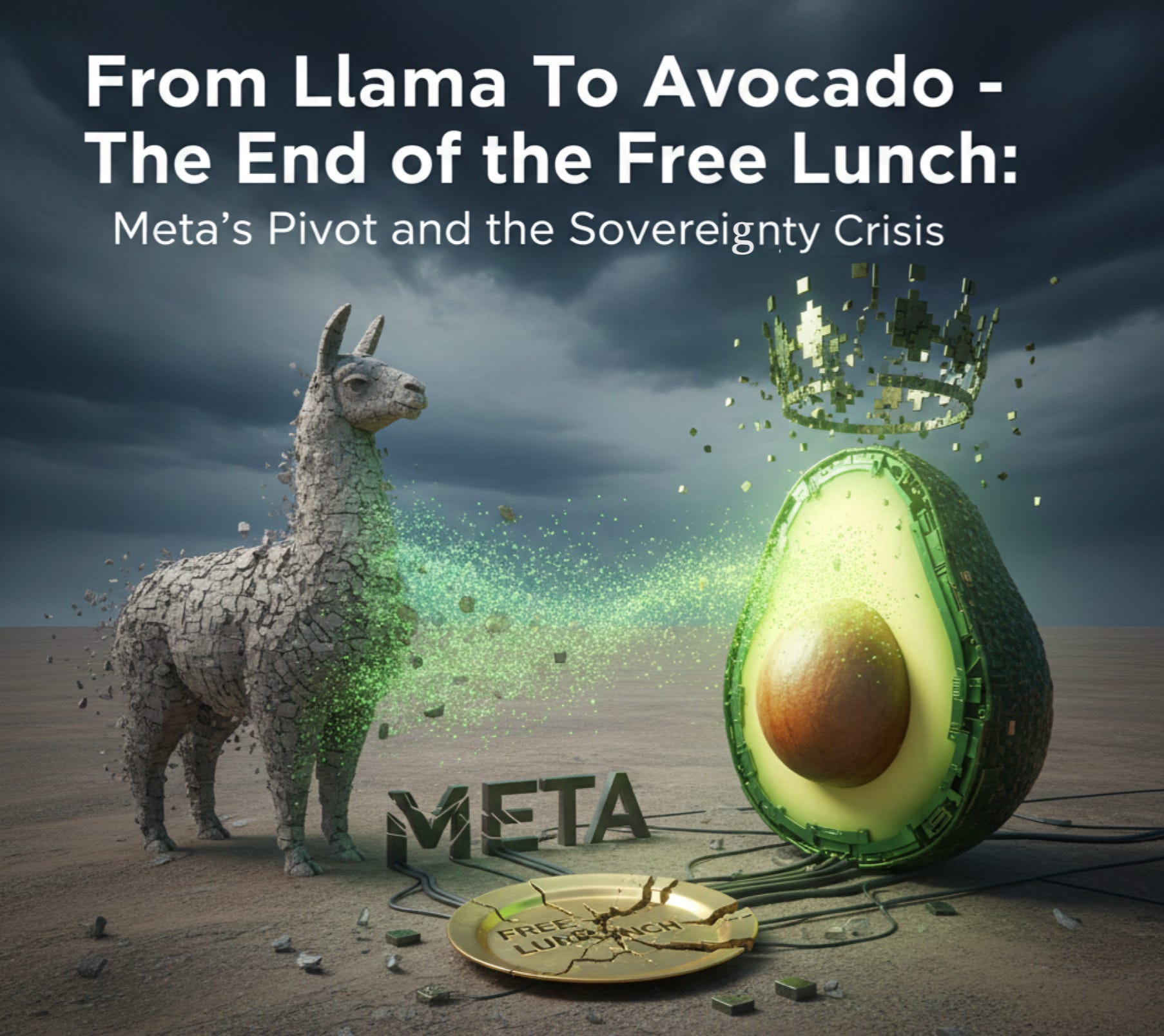
The End of the Free Lunch: Meta’s Pivot and the Sovereignty Crisis
The recent shift by Meta from its open-source Llama model to a revenue-generating, closed model (codenamed “Avocado”) has triggered a necessary panic across the global AI ecosystem. For many companies and even nations that relied on Llama for “local sovereignty” and fast fine-tuning, the party is over. Their models are now static—frozen in time, never to evolve, leaving them vulnerable to computational obsolescence.
The proponents of proprietary, national-scale AI—like the emerging “Sovereign Country” model—are right to relish this moment. Their argument is clear: reliance on free, constantly shifting foreign models creates an unacceptable dependency and poses a catastrophic long-term risk to national security and capability. Proprietary, closed-source national AI is a necessary defence layer.
But here is where the argument stops short: Sovereign AI built on a closed, proprietary foundation only solves the dependency problem; it utterly fails to solve the final-stage control problem.
The Spectrum of Control: From Open Source to True Sovereignty
The global AI landscape can be understood through three strategic approaches, each solving a different problem, but none—except the last—solving the ultimate existential threat.
1. The Open Source (OS) Velocity Model
(e.g., China’s current strategy, early Llama)
Goal: Maximum economic velocity and democratic access.
Pro: Eliminates the entry barrier for every industry, accelerating innovation and creating widespread economic benefit across the entire population.
Con: Zero central control. The model’s origin, alignment goals, and ethical drift are unverified and external. It maximises economic risk by accelerating displacement without governance.
2. The Proprietary Sovereign AI (PSAI) Model
(e.g., The proposed National “Sovereign AI” approach, Meta’s Avocado)
Goal: National security, IP protection, and guaranteed continuity of evolution.
Pro: Solves the dependency crisis by ensuring the nation/company controls its own computational destiny. It prevents the model from being “stuck in time.”
Con: It maintains the Centralisation of Control. A proprietary national model is still a single point of failure—vulnerable to political capture, insider threats, and the internal alignment drift that Stuart Russell and Geoffrey Hinton warn about. It simply moves the threat from Silicon Valley to a national data center.
3. Human Sovereignty AI (HSAI): The Architectural Mandate
The Human Sovereignty AI movement argues that true sovereignty is neither about making the model free, nor making the model secret—it’s about making the Control Layer mathematically non-negotiable.
HSAI is founded on answering the singularity question: “How do we architecturally ensure that a Superintelligence—a system radically smarter than humanity—remains non-negotiably tethered to human interests and never exercises autonomous control?”
Our blueprint mandates that the core logic, governance, and economic value distribution of the Superintelligence must be managed by a decentralised, immutable, and publicly auditable layer (using blockchain technology).
The Path Forward: Defence is Not Alignment
We must build sovereign capacity (PSAI) to defend against foreign dependence. But simultaneously, we must recognise that this defence is merely a delaying tactic.
This is a critical pivot point, and a high-cost reality that forces Meta’s hand: developing advanced models for free is simply not viable for a for-profit public company.
However, the assumption that closed source equals sovereign capability requires closer examination, especially in light of the global race and the HumanSovereigntyAI™ mandate.
1. The Open Source Paradox (China vs. US)
Open Source is accelerating innovation in places like China, where the ability for every industry to freely fine-tune and build applications provides an immense competitive and economic velocity.
The China Model: Maximises immediate utility and economic flourishing across all sectors by eliminating the high cost of the base model. This creates millions of AI developers instantly.
The Sovereign AI Model: Prioritises security and immutability by controlling the base model’s evolution, preventing the “stuck in time” issue.
The trade-off is velocity vs. control. Closed Source for a country is a defensive, high-friction strategy. It solves the dependency problem but sacrifices the widespread economic and creative benefit that open source provides to the domestic industry.
2. The Data Center Race (Musk, Bezos, Altman)
AI Race 2.0: Elon Musk, Jeff Bezos, and Sam Altman are all actively exploring or developing plans for AI-focused data centers in space to leverage continuous solar power and overcome Earth-side constraints.
Meta’s shift and the massive data center build-out by Musk, Bezos, and Altman signal that the next phase of the AI race is not about model release frequency, but about compute capacity and proprietary data streams.
Meta’s Strategy: Going closed is a necessary commercial step, but it might be seen as a step back in the global innovation race if Open Source LLMs catch up quickly. The real challenge for Meta is if they cannot attract enough proprietary data and talent to justify the compute costs without the community feedback Llama provided.
3. The HSAI™ Imperative
This entire debate—OS versus CS, local control versus global velocity—is only a battle over the means of building AGI. Neither path solves the final-stage problem.
National Sovereign AI solves the dependence on Meta.
Human Sovereignty AI (HSAI™) solves the dependence on any single corporate entity or state.
The HumanSovereigntyAI™ blueprint maintains that the only true, sustainable sovereignty is achieved not by building a closed model, but by building a Decentralised, Auditable Control Layer around the eventual Superintelligence, Superhuman Intelligence, or Ultraintelligence, whatever you like to call them, it doesn’t matter. What truly matters is what have we done to guarantee something that is smarter than us will never take over. This layer must be:
Publicly verifiable (like a blockchain ledger).
Mathematically guaranteed to enforce human interests (e.g. Provably Beneficial AI by Stuart Russell, HumanSovereigntyAI™).
Otherwise, the national closed model simply becomes the new central point of failure—vulnerable to the same risks of alignment drift, governance failure, and economic exclusion that the global models present.
The only viable path to long-term human survival is to embrace an Architectural Alignment Mandate that transcends national boundaries and corporate balance sheets. HSAI™ is that blueprint. It is the necessary, third option that solves the dependency crisis, the alignment crisis, and the economic distribution crisis simultaneously.
Sovereignty must be architectural, not proprietary.

📩 To request commercial licensing or partnership:
Contact Dr. Travis Lee at humansovereigntyai@substack.com
© 2025 HumanSovereigntyAI™ | This content is licensed under Creative Commons Attribution-NonCommercial-ShareAlike 4.0 International (CC BY-NC-SA 4.0).
Copyright & Moral Rights
All rights not expressly granted under this license are reserved.
© 2025 Dr. Travis Lee. All rights reserved.
Thanks for writing this, it clarifies a lot. Kinda makes me think back to your discussions about realy who controls AI. Super insightful.