
Enterprise AI: The Constitutional Knowledge Boundary
Where Enterprise AI Governance Actually Begins | Enterprise AI Insights Series — Paper 3

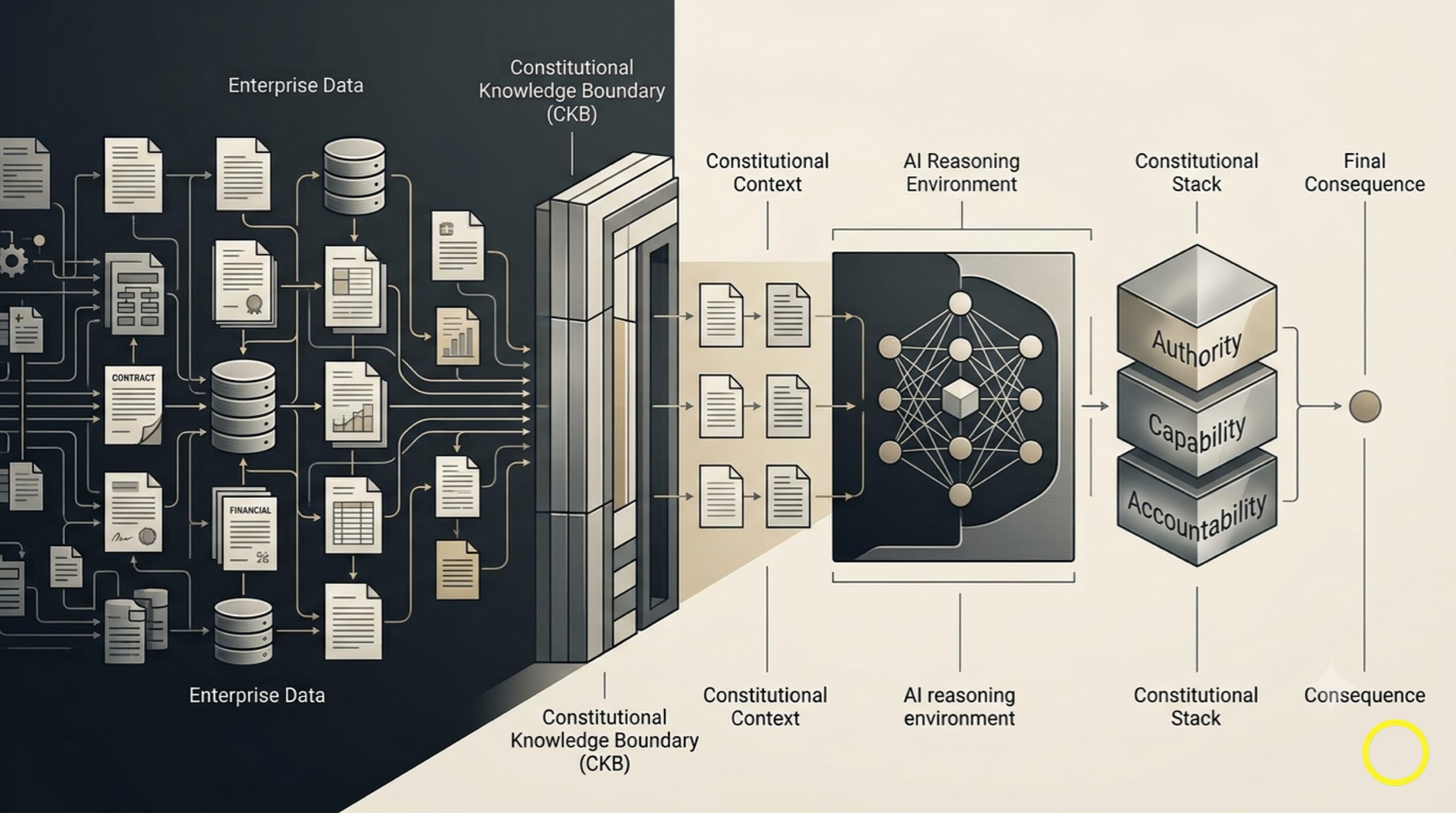
1. Enterprise AI Still Governs Too Late
Enterprise AI has made remarkable progress in recent years. Organisations have invested heavily in foundation models, retrieval systems, orchestration frameworks, identity management, access controls, audit logging and increasingly sophisticated governance processes. Yet despite this growing maturity, one architectural assumption has remained largely unquestioned.
Enterprise AI governance still begins too late.
Most governance frameworks focus on what happens after intelligence has already received the information required to perform its task. They govern outputs, execution, compliance, accountability and operational risk. They determine whether an action should proceed, whether a decision complies with policy, and whether sufficient evidence exists to explain what occurred.
These controls are important, but they remain incomplete because they assume that governance begins once intelligence has already acquired the knowledge required to perform its task.
HumanSovereigntyAI begins from a different premise.
Before intelligence reasons, plans, recommends or executes, there is a more fundamental constitutional question: What is intelligence constitutionally permitted to know?
This question rarely appears in enterprise AI architecture because visibility has traditionally been treated as a technical concern rather than a constitutional one. Identity determines who may access information. Permissions determine which systems may retrieve it. Encryption protects it during storage and transmission.
Together, these mechanisms answer an important operational question: whether the information can be accessed. They do not answer the deeper constitutional question of whether this intelligence should be permitted to observe that information in the first place.
That distinction marks the beginning of AI Governance 2.0.
The next generation of enterprise AI will not be defined solely by more capable models or larger context windows, but by architectures that recognise that governance does not begin at execution. It begins at knowledge.
2. The Hidden Architectural Assumption
Much of today's enterprise AI architecture still rests on an implicit assumption: governance begins after information has been made available to intelligence for reasoning.
Existing controls may restrict access, filter data, or enforce policy, but they rarely treat the admissibility of knowledge itself as a constitutional question. The implementation details may differ. Some organisations deploy cloud-hosted foundation models. Others operate private infrastructure or self-hosted open-weight models. Some rely on retrieval-augmented generation, while others build increasingly sophisticated agentic systems.
Beneath these architectural differences lies a common sequence: information becomes visible, intelligence reasons over it, and governance evaluates what should happen next.
This ordering has become so familiar that it is rarely questioned. Identity management determines who may access enterprise resources. Permissions define which repositories can be queried. Retrieval systems assemble relevant documents. The model receives the resulting context and begins reasoning. Only afterwards do governance mechanisms evaluate outputs, authorise execution, record audit trails or enforce organisational policy.
The architecture appears sensible because it reflects how enterprise software has traditionally been designed.
Yet it quietly embeds a constitutional assumption.
It treats visibility as a technical consequence of access rather than as a constitutional decision in its own right.
Once information has been retrieved, enterprise architecture largely treats knowledge as an operational resource whose only remaining question is how it should be used. Governance therefore concentrates on behaviour after reasoning has already occurred rather than on the constitutional legitimacy of the knowledge that made the reasoning possible.
The omission persists because enterprise architecture has historically treated visibility as a technical consequence of authentication, authorisation and retrieval rather than as a constitutional decision.
They do not ask whether that information should become visible to this intelligence for this decision under these constitutional conditions.
The omission is understandable. Traditional enterprise systems were built around human users whose authority could often be assumed through organisational roles and professional accountability. Artificial intelligence changes that assumption. Intelligence is no longer simply retrieving information on behalf of a human operator. Increasingly, it participates directly in reasoning, recommendation, planning and decision support.
The moment intelligence becomes an active participant rather than a passive tool, visibility itself becomes a constitutional event.
This is where today’s enterprise architecture reaches its limit. It has become increasingly sophisticated at governing execution, yet it has not developed an equivalent architecture for governing what intelligence itself is permitted to know.
3. Visibility Is Not Neutral
Enterprise AI has traditionally treated visibility as a technical capability: if identity has been verified, permissions granted and information retrieved according to policy, the architectural problem is considered solved. The intelligence now possesses the knowledge required to perform its task.
From that point onward, governance shifts its attention elsewhere. It evaluates outputs, authorises actions, records evidence and monitors execution.
HumanSovereigntyAI begins from a different observation.
Visibility is not merely a technical event but a constitutional one, because the moment information becomes observable to intelligence, that information becomes part of the causal environment from which subsequent inference, recommendation and action emerge. Governance that begins only after visibility has occurred therefore governs the consequences of a decision without governing one of the conditions that produced the decision in the first place.
Constitutional Visibility is the condition under which information becomes observable to intelligence for a defined purpose, subject to constitutional constraints on whether that knowledge is legitimate to expose.
The moment intelligence observes information, the constitutional state of the system changes. Knowledge cannot be unseen. Once incorporated into reasoning, it influences every inference, recommendation and conclusion that follows. Governance therefore cannot begin only after reasoning has taken place because the reasoning itself has already been shaped by what intelligence was permitted to know.
This distinction has profound implications for enterprise architecture.
Conventional enterprise architecture asks whether intelligence can access information. HumanSovereigntyAI asks whether that intelligence should be constitutionally permitted to know the information for the decision at hand.
These questions are not equivalent.
A financial planning agent may legitimately require revenue forecasts while having no constitutional basis for examining confidential employee medical records; a procurement assistant may require supplier performance data without becoming aware of unrelated legal investigations; and a hiring assistant may need candidate qualifications while remaining prohibited from observing information that could improperly influence employment decisions.
None of these examples are problems of authentication or permissions.
They are problems of constitutional legitimacy.
The issue is no longer whether information can be accessed securely. It is whether the visibility itself remains constitutionally justified for the reasoning that follows.
This marks a fundamental departure from conventional enterprise AI architecture.
Visibility is therefore no longer merely the beginning of intelligence; it becomes the first object of governance.
Only when visibility itself becomes constitutionally governed can reasoning remain constitutionally legitimate from its very first inference.
4. The Constitutional Knowledge Boundary
If visibility itself becomes a constitutional question, then enterprise AI requires an architectural mechanism that governs visibility before intelligence begins reasoning.
HumanSovereigntyAI introduces this mechanism as The Constitutional Knowledge Boundary (CKB).
Constitutional Visibility describes what may become visible; the Constitutional Knowledge Boundary is the architectural mechanism that determines where that visibility begins and ends.
The Constitutional Knowledge Boundary should not be confused with "Constitutional Admissibility" as defined in Layer 4 of the Constitutional Stack. Layer 4 determines whether a proposed action remains constitutionally admissible under current conditions. The CKB operates earlier: it determines what knowledge is constitutionally admissible to enter the reasoning environment.
The CKB is therefore the architectural boundary governing knowledge; Layer 4 is the constitutional boundary governing consequential action.
The Constitutional Knowledge Boundary is not part of the Constitutional Stack itself. It exists before the stack begins.
This distinction is deliberate.
The Constitutional Stack governs how intelligence is authorised, constrained and ultimately permitted to execute consequential actions. Its concern is constitutional authority over intelligence that is already reasoning.
The Constitutional Knowledge Boundary governs something more fundamental.
It determines what intelligence is constitutionally permitted to know before reasoning ever begins.
This makes it the first constitutional boundary encountered when enterprise information is requested for machine reasoning.
Rather than allowing enterprise data to flow directly into retrieval pipelines or foundation models, every request first encounters the Constitutional Knowledge Boundary. Its responsibility is not to optimise retrieval, maximise context or improve model performance, but to determine what knowledge may legitimately enter the reasoning environment.
The answer does not depend solely upon access permissions or organisational ownership. It depends upon constitutional legitimacy.
Identity may establish who initiated the request.
Permissions may establish what repositories are technically accessible.
The Constitutional Knowledge Boundary determines which portions of that accessible information remain constitutionally admissible for the reasoning that follows.
This changes the architecture fundamentally.
Enterprise AI assumes that intelligence receives knowledge first and governance evaluates consequences afterwards.
The Constitutional Knowledge Boundary reverses that order by governing the conditions under which knowledge becomes visible to intelligence. Governance therefore no longer begins only after knowledge has been acquired; it begins by determining what knowledge may legitimately enter the reasoning environment.
Only information that remains constitutionally admissible is permitted to cross the boundary.
Everything else remains outside the constitutional scope of the intelligence, regardless of whether it exists within the enterprise or could technically be retrieved.
The distinction may appear subtle, yet it transforms the role of governance.
Enterprise AI no longer asks how intelligence should behave after observing enterprise knowledge.
It first determines what intelligence is constitutionally permitted to observe at all.
5. Constitutional Context
The Constitutional Knowledge Boundary does not exist simply to reduce the amount of information available to intelligence. It exists to govern the conditions under which information becomes part of the reasoning environment.
This distinction is essential because the objective is not to make intelligence less capable. The objective is to ensure that reasoning begins from knowledge that is constitutionally legitimate rather than merely technically accessible.
What passes through the Constitutional Knowledge Boundary becomes Constitutional Context.
Constitutional Context is neither the largest possible collection of relevant information nor simply the subset most likely to maximise statistical confidence. It is the body of knowledge that remains constitutionally admissible for a particular intelligence, mandate, decision and moment.
This differs fundamentally from conventional retrieval.
Most enterprise AI systems optimise for semantic relevance. They attempt to maximise the probability that the retrieved information will help the model answer the user’s request. The underlying assumption is straightforward: more relevant information should produce better reasoning.
HumanSovereigntyAI introduces an additional constitutional dimension.
Information must first be constitutionally admissible before semantic relevance becomes meaningful.
A document may be highly relevant to the task while remaining constitutionally inappropriate for the intelligence performing it. Conversely, information that is constitutionally admissible but only marginally relevant may still remain available because it falls within the legitimate scope of the reasoning process.
Constitutional Context therefore represents the intersection of knowledge that is constitutionally admissible, decision relevance and the conditions under which reasoning is authorised to occur.
Knowledge domain:
♣︎ constitutionally admissible knowledge
Action domain / Layer 4 of Constitutional Stack:
♠︎ Constitutional Admissibility
The information must contribute meaningfully to the decision being made.
It must also remain legitimate for this intelligence to know.
This changes the optimisation objective of enterprise AI.
Today’s retrieval systems seek to maximise informational completeness, while the Constitutional Knowledge Boundary seeks to establish constitutional legitimacy before reasoning begins. The consequence is that relevance alone can no longer determine what enters the reasoning process. Completeness assumes that better reasoning emerges from broader visibility; Constitutional Context instead recognises that better judgement often depends upon disciplined visibility. The objective is therefore not to provide intelligence with everything it could know, but with everything it is constitutionally justified to know, so that reasoning begins upon a foundation that is not merely informative but legitimate.
6. Constitutional Inference
Once Constitutional Context has crossed the Constitutional Knowledge Boundary, intelligence begins reasoning.
In the Constitutional Stack, this reasoning occurs within Layer 5 — Intelligence; the CKB is upstream of the Stack and therefore governs the knowledge environment in which Layer 5 operates. This is where Constitutional Inference begins.
Constitutional Inference does not determine what intelligence is permitted to know. That decision has already been made. Nor does it determine whether a proposed action remains constitutionally admissible. That responsibility belongs later to the Constitutional Stack.
Its purpose is different. Constitutional Inference describes the reasoning discipline through which intelligence operates within the constitutional boundaries established before reasoning begins.
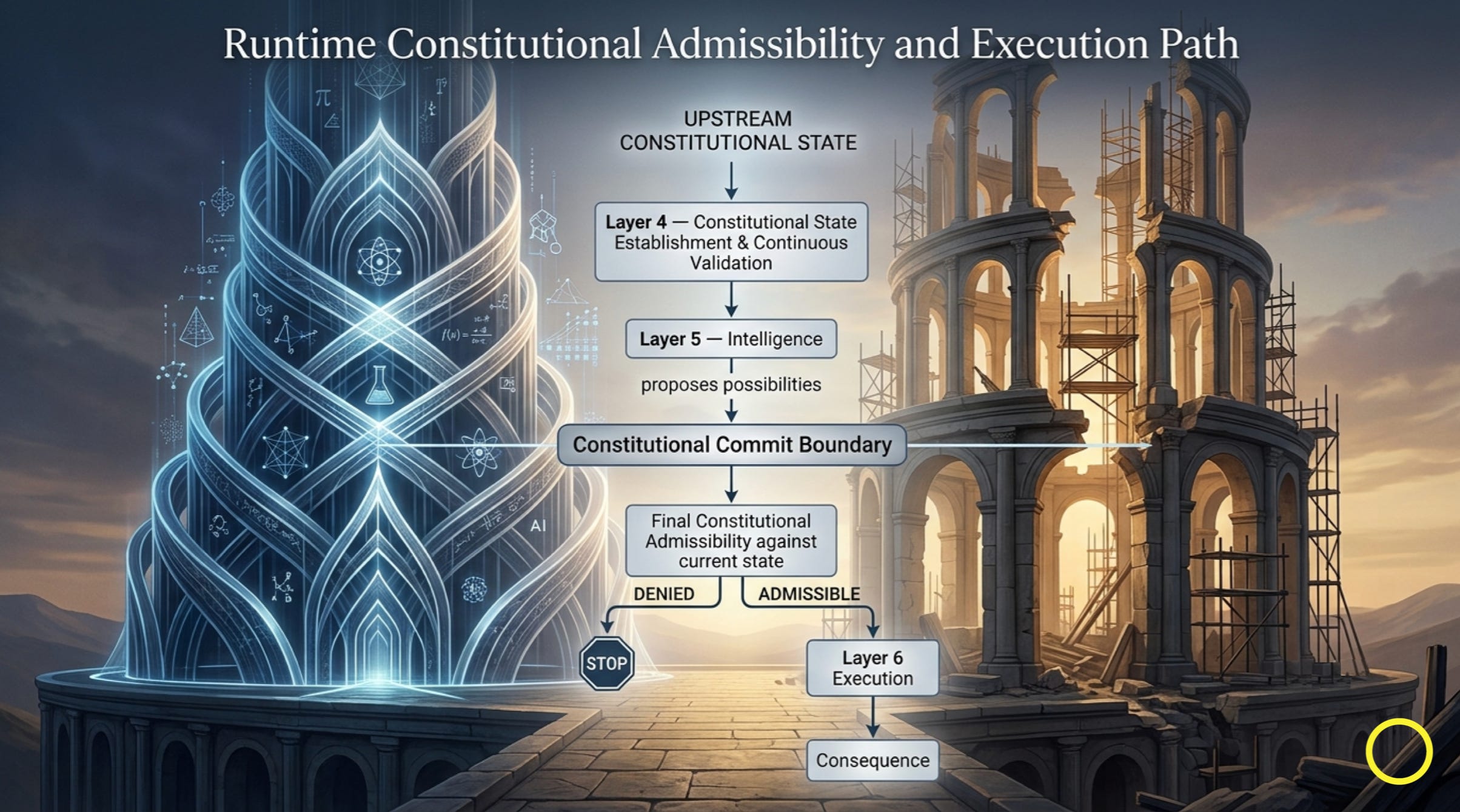
Figure 1 — Constitutional State and Consequence Admissibility Path
It does not filter knowledge, authorise action or determine whether an outcome may be executed. Those decisions belong respectively to the Constitutional Knowledge Boundary and the Constitutional Stack.
Conventional inference assumes that every piece of available context contributes equally to producing the best possible answer. The objective is to optimise prediction, maximise accuracy, or generate the most probable response from the information provided.
Constitutional Inference introduces a different objective.
Reasoning must remain continuously faithful to the constitutional conditions under which the knowledge became visible.
Constitutional Context defines the legitimate scope of knowledge.
Constitutional Inference preserves the legitimate use of that knowledge.
The model is therefore not asked simply to produce the most statistically probable response. It is expected to reason in a manner that remains consistent with the constitutional mandate under which the context was admitted.
This transforms inference from a purely computational process into reasoning that remains bounded by the constitutional conditions under which its context was admitted.
The objective is no longer unrestricted optimisation. It is constitutionally legitimate judgement.
This mirrors how human institutions already operate. A judge reasons only over evidence that has been admitted into the court. A medical specialist interprets clinical information within professional standards of care. A board deliberates within the authority granted by its charter. In each case, reasoning remains inseparable from the constitutional conditions that define its legitimacy.
Enterprise AI should be expected to operate no differently. Constitutional Inference does not make intelligence less capable. It makes its reasoning constitutionally coherent.
Layer 4 establishes and continuously validates the constitutional conditions under which intelligence may operate and consequential action may become admissible. Layer 5 provides the intelligence capability that reasons and generates proposals within those conditions. When a proposal seeks to become consequential, it must satisfy the Layer 4 admissibility function against the constitutional state existing at that moment. This is not a reverse flow in which Layer 5 returns to Layer 4 for further reasoning. It is the reapplication of an existing constitutional boundary at the point where possibility seeks permission to become consequence.
The Constitutional Stack now governs what happens to that reasoning: how authority is established, how capability remains constitutionally admissible, and whether consequence may proceed toward execution.
The Constitutional Stack now begins.
7. Architectural Trust Minimisation
Enterprise AI has largely approached governance as a problem of institutional trust.
Organisations ask whether they can trust the model provider with sensitive information. Vendors respond with contractual commitments, security certifications, encryption standards, data residency options and assurances that enterprise data will not be used to train foundation models. These commitments are necessary because today’s architecture requires them.
The trust itself remains part of the design. HumanSovereigntyAI begins from a different architectural principle. Rather than asking how trust can be strengthened, it asks why the architecture requires unnecessary trust in the first place.
This is the principle of Architectural Trust Minimisation.
Architectural Trust Minimisation does not assume that vendors are untrustworthy. Nor does it seek to eliminate trust entirely. Every distributed system depends upon some degree of institutional confidence. The objective is narrower and more practical.
Reduce the amount of trust the architecture requires by design. This shifts governance from contractual assurance towards constitutional architecture. Enterprise AI often depends upon promises made after enterprise information has already become visible to intelligence. The provider promises not to retain it, not to train upon it, or not to use it beyond the agreed purpose. These commitments remain valuable, but they all assume that constitutional visibility has already occurred.
HumanSovereigntyAI changes the order.
The Constitutional Knowledge Boundary determines what intelligence is constitutionally permitted to observe before visibility occurs. Constitutional Context limits the knowledge that becomes available for reasoning. Constitutional Inference ensures that reasoning remains faithful to the constitutional conditions under which that knowledge was admitted.
Trust is no longer concentrated in organisational promises. It is increasingly distributed into architectural constraints. The enterprise no longer asks only whether the provider will behave responsibly after receiving its information. It first asks whether the architecture requires the provider to receive that information at all.
This distinction transforms enterprise governance. The objective is not to eliminate trust, but to reduce the amount of trust the architecture requires by design.
The strongest enterprise AI architectures will therefore not be those that ask organisations to trust more, but those that require them to trust less.
8. Why Constitutional Boundaries Do Not Make AI Less Intelligent
The most immediate objection to this architecture is also the most reasonable: if intelligence is prevented from seeing some enterprise information, will its answers become less accurate? The answer depends on what the system is actually optimising for.
If the objective is to maximise the amount of information available to a model, then any constitutional boundary appears to be a constraint. But enterprise AI should not ultimately optimise for maximum visibility. It should optimise for the highest-quality reasoning that can legitimately support the decision being made.
More information does not necessarily produce better judgement. As enterprise context windows expand, the ability to expose a model to more information increases computational capacity without guaranteeing better reasoning. Irrelevant, conflicting or improperly scoped information can dilute signal, introduce false associations and create unintended influence. The relevant architectural question is therefore not how much the model can know, but what it needs to know to reason legitimately and well.
Human experts do not make better decisions simply because they are exposed to every piece of information available. A physician does not require an organisation’s entire employee database to diagnose a patient. A procurement executive does not need unrestricted access to every internal communication to evaluate supplier performance. A board does not improve every decision by admitting every fact that happens to exist within the organisation.
The quality of reasoning depends not only on how much information is available, but on whether the information is relevant, reliable and appropriate to the decision.
CKB introduces a condition that conventional relevance-based retrieval does not: information may be useful to the prediction and still be constitutionally impermissible to the reasoning.
This is why Constitutional Context should not be understood as a reduction of intelligence. It is a disciplined definition of the information within which intelligence is expected to reason.
The architectural objective therefore changes. The relevant architectural question is therefore not how much the model can know, but what it needs to know to reason legitimately and well.
That is the role of the Constitutional Knowledge Boundary.
It does not seek to hide information from intelligence for its own sake. It establishes the constitutional conditions under which information may become part of intelligence’s reasoning environment.
This also creates an important distinction between accuracy and legitimacy. An AI system may produce a statistically more accurate prediction by using information that it was never constitutionally entitled to observe. That may improve a benchmark while producing an unacceptable enterprise decision.
A hiring system might become more predictive if it secretly incorporated private medical information. A lending system might improve its risk prediction by exploiting information that should never influence eligibility. A procurement system might produce a more commercially efficient recommendation by incorporating confidential information outside its mandate.
The resulting prediction may therefore be more accurate while the decision remains illegitimate.
AI Governance 2.0 therefore cannot define better intelligence simply as greater predictive accuracy. The relevant objective is maximum constitutionally legitimate reasoning.
This is the deeper purpose of Constitutional Inference.
The model is not being made less intelligent by operating within legitimate boundaries. It is being prevented from treating every available piece of information as equally available for every possible purpose.
Enterprise AI has spent much of its development asking how to give intelligence more context. The next architectural question is more difficult: Which context should intelligence be constitutionally permitted to have?
That is not a limitation on intelligence.
It is the beginning of constitutionally bounded intelligence.
9. Where Enterprise AI Governance Actually Begins
Enterprise AI has become increasingly sophisticated at governing access, retrieval, intelligence and execution, yet the architecture has largely left one constitutional question unresolved: what intelligence is permitted to know before reasoning begins?
Yet much of this architecture still assumes that governance begins after intelligence has acquired the knowledge required to reason.
The Constitutional Knowledge Boundary challenges that assumption. It places the first constitutional question before inference itself.
What is intelligence permitted to know?
From that question follows an architectural sequence that is different from conventional enterprise AI. The resulting architecture can be represented as follows.
Figure 2 — Enterprise Constitutional Architecture: Knowledge to Consequence
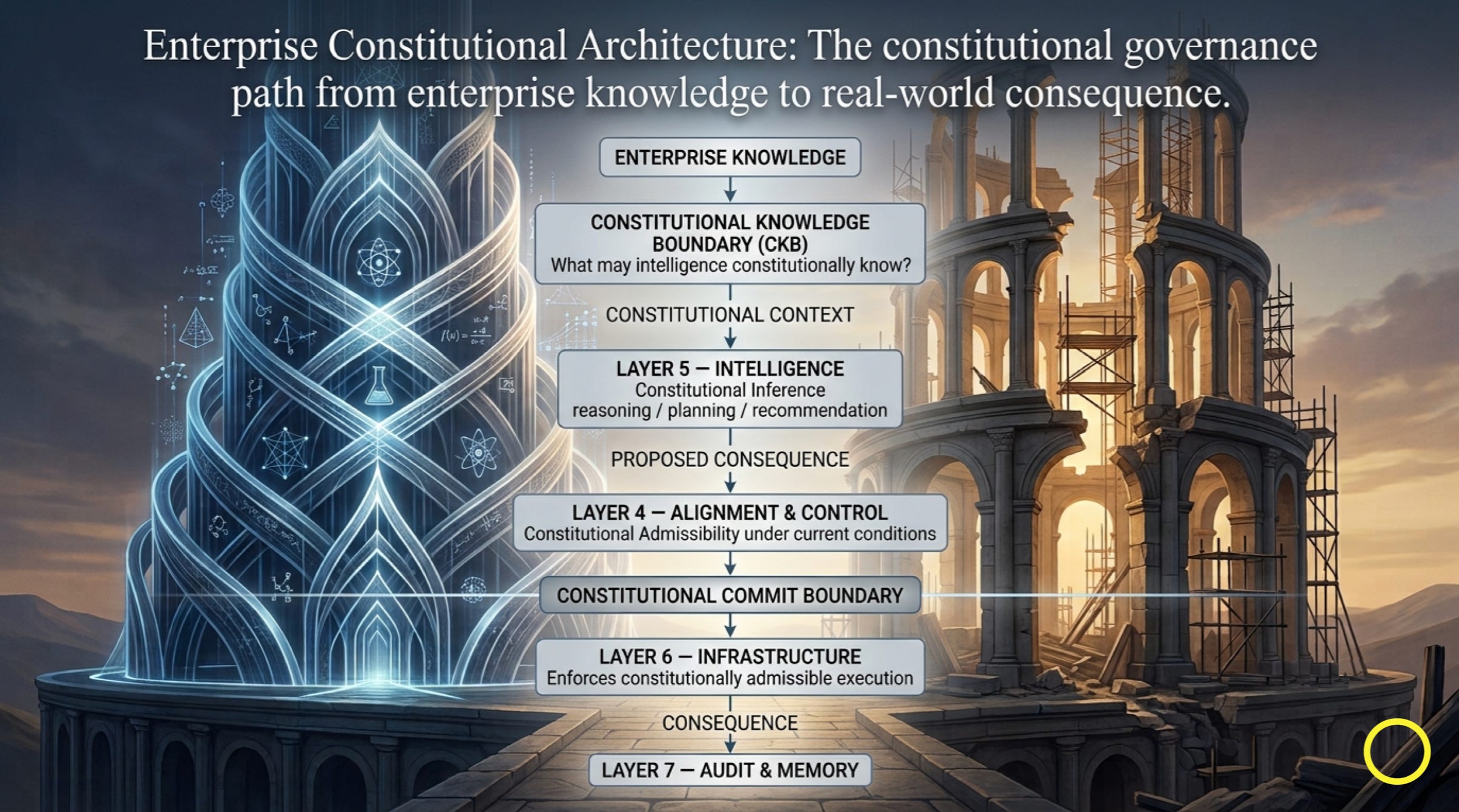
(Note: The numerical ordering of the Constitutional Stack describes constitutional function and separation, not a simple linear processing sequence. Layer 5 provides intelligence and generates possibilities; Layer 4 provides constitutional admissibility; the Constitutional Commit Boundary prevents any possibility from becoming consequence unless the required constitutional conditions remain valid.)
Enterprise data does not flow directly into intelligence simply because access has been technically authorised. It first encounters a constitutional boundary that determines whether the information is legitimate within the authorised reasoning context for the specific purpose at hand. The knowledge permitted through the boundary constitutes the Constitutional Context within which the intelligence reasons. Intelligence reasons within that context through Constitutional Inference. Only then does the Constitutional Stack govern authority, admissibility and execution.
The distinction matters because these are different constitutional problems.
The Constitutional Knowledge Boundary governs the conditions of knowledge. The Constitutional Stack governs the conditions of action.
One determines what intelligence may know before reasoning begins. The other determines what intelligence may do once reasoning has occurred. Neither replaces the other. Together they create a continuous constitutional architecture from knowledge to consequence.
This also changes the enterprise trust equation. The traditional question is whether an organisation can trust the provider with its data. The architectural question is more fundamental: how much of that trust can the system eliminate through design?
A mature enterprise AI architecture should not depend entirely on promises made by institutions after information has already crossed into infrastructure they control. It should progressively minimise the amount of unnecessary visibility that architecture itself permits.
That is the deeper purpose of Architectural Trust Minimisation.
The consequence is an architectural progression from knowledge to reasoning, from reasoning to authority, and from authority to execution, with each stage governed by a distinct constitutional boundary.
This is where Enterprise AI Governance 2.0 begins. Not with another policy layer. Not with another compliance framework. Not with another promise that sensitive information will be handled responsibly after intelligence has already seen it.
It begins by governing the conditions under which intelligence is permitted to know, reason and ultimately act. The Constitutional Knowledge Boundary is therefore not an additional control placed around enterprise AI. It is a recognition that governance existed one architectural layer too late.
Enterprise AI has learned how to control access to information. The next generation must learn how to govern its visibility. And once visibility becomes constitutional, inference, authority and execution can finally become part of the same architectural discipline.
Enterprise AI Insights Series
✓ Paper 1 — Enterprise AI Doesn’t Have an AI Problem. It Has a Decision Problem.
✓ Paper 2 — Enterprise AI Doesn’t Scale Because Organisations Don’t
✓ Paper 3 — Enterprise AI: The Constitutional Knowledge Boundary
→ Paper 4 — Enterprise AI Doesn’t Need Better Models. It Needs Better Operating Models
HumanSovereigntyAI Enterprise
Enterprise AI Insights Series
August 2026
© 2026 Travis Lee | HumanSovereigntyAI™
This article is licensed under the Creative Commons Attribution–NonCommercial–ShareAlike 4.0 International (CC BY-NC-SA 4.0).
Framework names, architectural concepts, trademarks, and related intellectual property remain protected and are not covered by this licence.
See the About page for licensing, trademark, and intellectual property terms.
Once data enters a model's context window, it permanently alters the causal reasoning path. Governing outputs or enforcing policies after intelligence has already ingested sensitive information is governing one step too late.